Places
In PastPaths, places aren't just names typed into a text field — they're objects with a life of their own. When you link a person to a place, you can later see "everyone in the family who's lived in Hagfors" or "all events that took place at Mariakyrkan."
Create a place
You can create places in two ways:
Go to Places → + Add place.
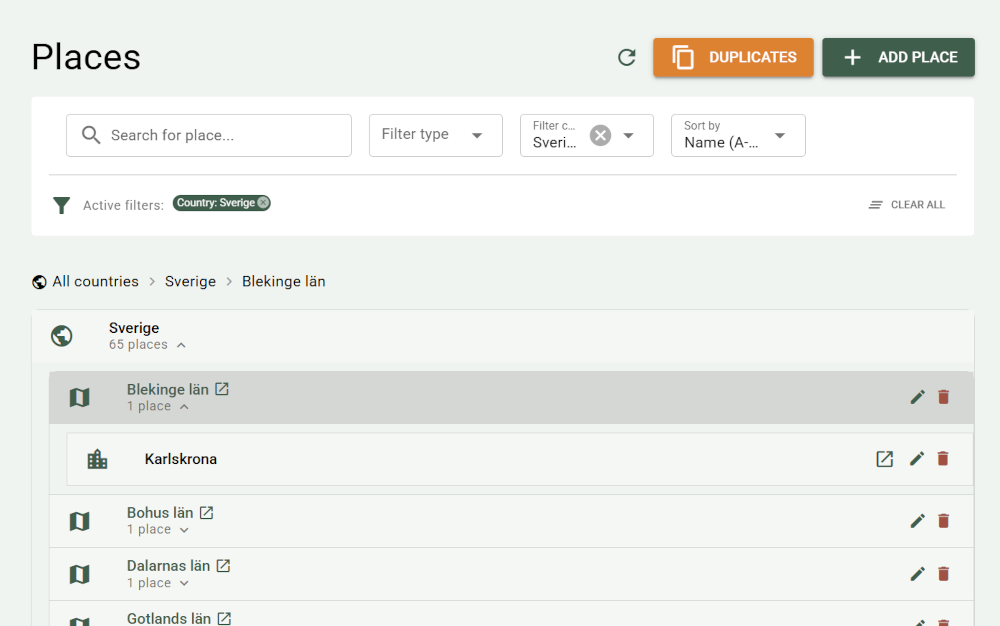
When you fill in, for example, a person's place of birth — start typing the place name. If the place already exists, it will be suggested. If not, you can create it directly without leaving the form.
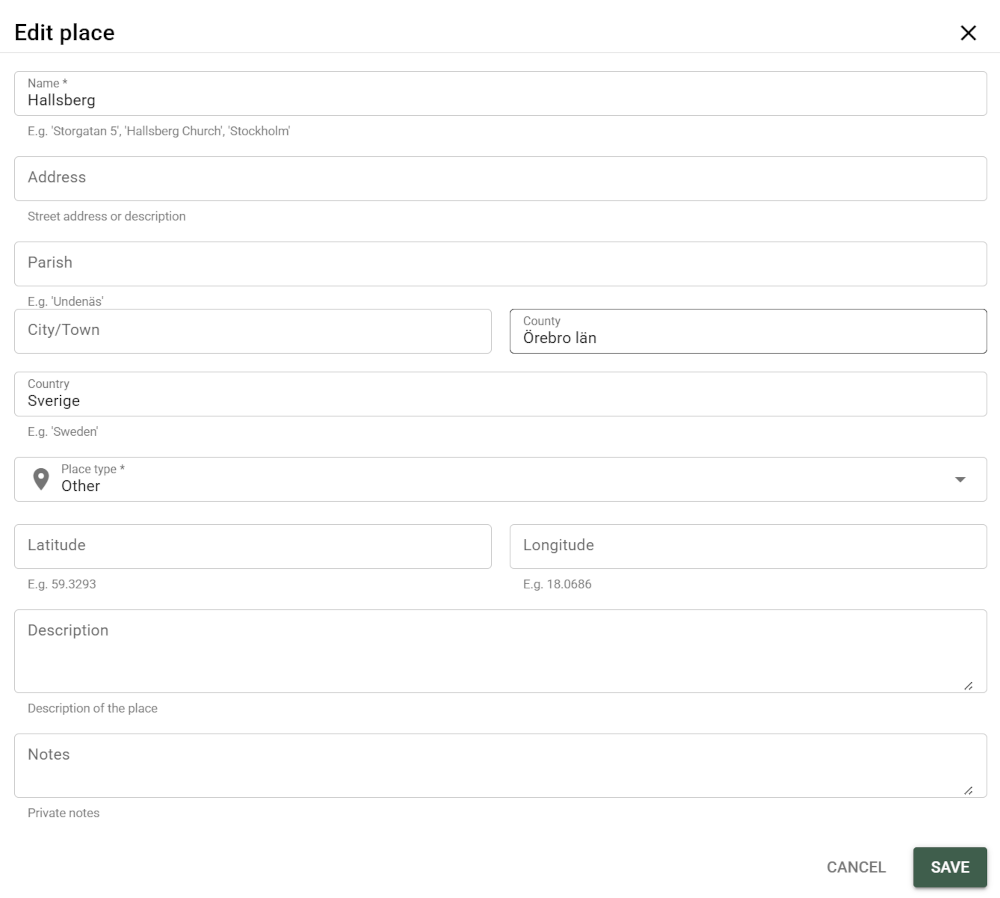
What can you fill in?
A place can have:
- Name — e.g. "Härnösand," "Långsjö farm," "Mariakyrkan"
- Address — street address or a closer description
- City/town
- Parish
- County/province
- Region — state, province, or Bundesland. Only relevant for some countries (e.g. Belgium, USA, Germany) — leave blank otherwise, e.g. for Sweden.
- Country
- Place type — city, church, farm, village, province, diocese, etc.
- GPS coordinates — for map display
- Notes — free text about the place
- Photos of the place
Country, county, parish, and city suggest existing values from your own database as you type — so the same place is spelled the same way every time, instead of e.g. "Stockholm County" and "Stockholms län" becoming two different values. You can still type in a brand new value if what you're looking for doesn't exist yet.
Default country
Under Account → Default country, you can set which country is suggested automatically whenever you add a new place. Handy if almost all your places are in the same country — you won't need to type it every time, and you can always change it for individual places.
Place Library — ready-made packs
Instead of typing in common reference places (counties, states, parishes) by hand, you can import them as ready-made packs via Administration → Library. Gives you a consistently spelled foundation to build on, so the same place doesn't end up as several different entries.
→ More about the Place Library
Link places to persons
A person is linked to a place through events — not through a separate "add place" connection. When you enter a person's birthplace or place of death directly in the person form, a connection to that place is created automatically. For every other kind of place connection — residence, occupation, education, marriage, visits — you add an event for the person and specify the place there.
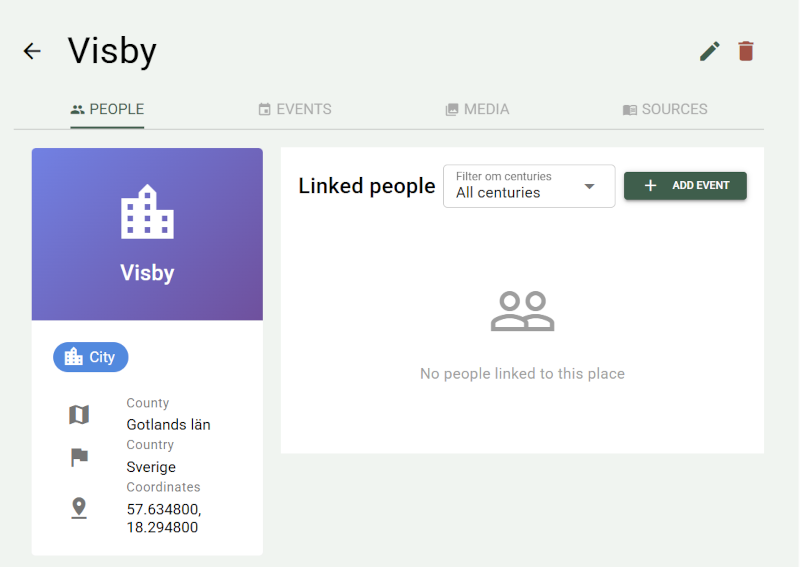
That means a place's page shows everyone who's been connected to it in any way: born there, died there, lived there, married there, or had an occupation there — all gathered under the "Persons" tab.
Link places to events
When you create an event (marriage, baptism, emigration), you specify where it took place. That place is then linked to the event automatically.
Map
If you enter coordinates for a place, it will be shown on the map.
Browsing places
The places list is built as a hierarchy rather than one long, flat list — handy as soon as you have more than a handful of places to keep track of.
You click your way through the levels in order:
- Country — a grid of every country you have places in, and how many places each
- Region (only shown when relevant) — for countries with a fourth administrative level, e.g. a US state, a Belgian province, or a German Bundesland. If none of your places in that country have a region filled in — as with Sweden — this step is skipped automatically.
- County — the counties within the chosen country (or chosen region, for countries that use the region level). Provinces and dioceses also appear here as rows of their own, since they sit at the same level as counties without being counties
- Parish/city — parishes or cities within the chosen county
- Individual places — the usual card or list view, limited to the chosen area
A breadcrumb at the top shows where you are in the hierarchy ("All countries / Sweden / Stockholm County", or for a country with a region level: "All countries / Belgium / Wallonia / Liège"), and you can click back to any earlier level. If you search by name instead, the search bypasses the hierarchy entirely and shows a flat list of results across your whole database, just like before.
Places missing a value at a given level (e.g. no county entered) end up in their own group — "Unknown country," "Unknown region," "Unknown county," or "Unknown parish" — so they're never lost from the list.
Search and filter places
In the places list's search box, you can search by name regardless of where you are in the hierarchy. Search, the place-type filter, the tag/category filter, the missing-coordinates filter, and the country filter (dropdown) all bypass the hierarchy the same way and show a flat, sortable list of results across your whole database — only clicking within the hierarchy itself (cards and breadcrumbs) drills down level by level.
Place statistics
From the welcome page you'll find a summary of statistics about your places — most common countries, counties, and parishes — with a "More statistics" link to a full statistics page.
The statistics page shows:
- Most common countries and counties — number of places per country/county; click a row to jump straight into that part of the hierarchy
- Most common place types — distribution across church, farm, village, etc.
- Most connected persons and events — which places show up the most in your research
- Missing coordinates — how many places aren't mapped yet, with a link to a filtered list
- Most common cemeteries
- Oldest and most recent recorded event — which places have the oldest and most recently dated event linked to them
- Most common emigration/immigration places — especially relevant if your family emigrated
Residents by place
On a place's detail page, under the "Persons" tab, you can filter the connected persons by century — handy for, say, seeing who lived on a particular farm specifically during the 1800s, without scrolling through every century at once. The dropdown automatically suggests the most recent century with recorded data for that specific place.
Migration patterns
Still on a place's "Persons" tab, a card shows where people came from and where they moved on to, based on each person's chronologically sorted residences. It gives a quick picture of migration patterns for the place — especially useful for tracing emigration waves or common migration routes between towns.
Requires a start date
Migration patterns can only place a residence in the right chronological order if it has a start date. If a connection is missing a date, it won't show up in this card, even though it's still included in the other statistics.
Delete a place
If a place is linked to persons or events, you may need to remove those links first — or choose to reassign them to another place when deleting.

See also
- Place Library — import ready-made packs of reference places instead of typing them in by hand
- Events — how places are linked to events and persons
- Media — photos and documents linked to a place, with the same card/list view switching as on the Media page